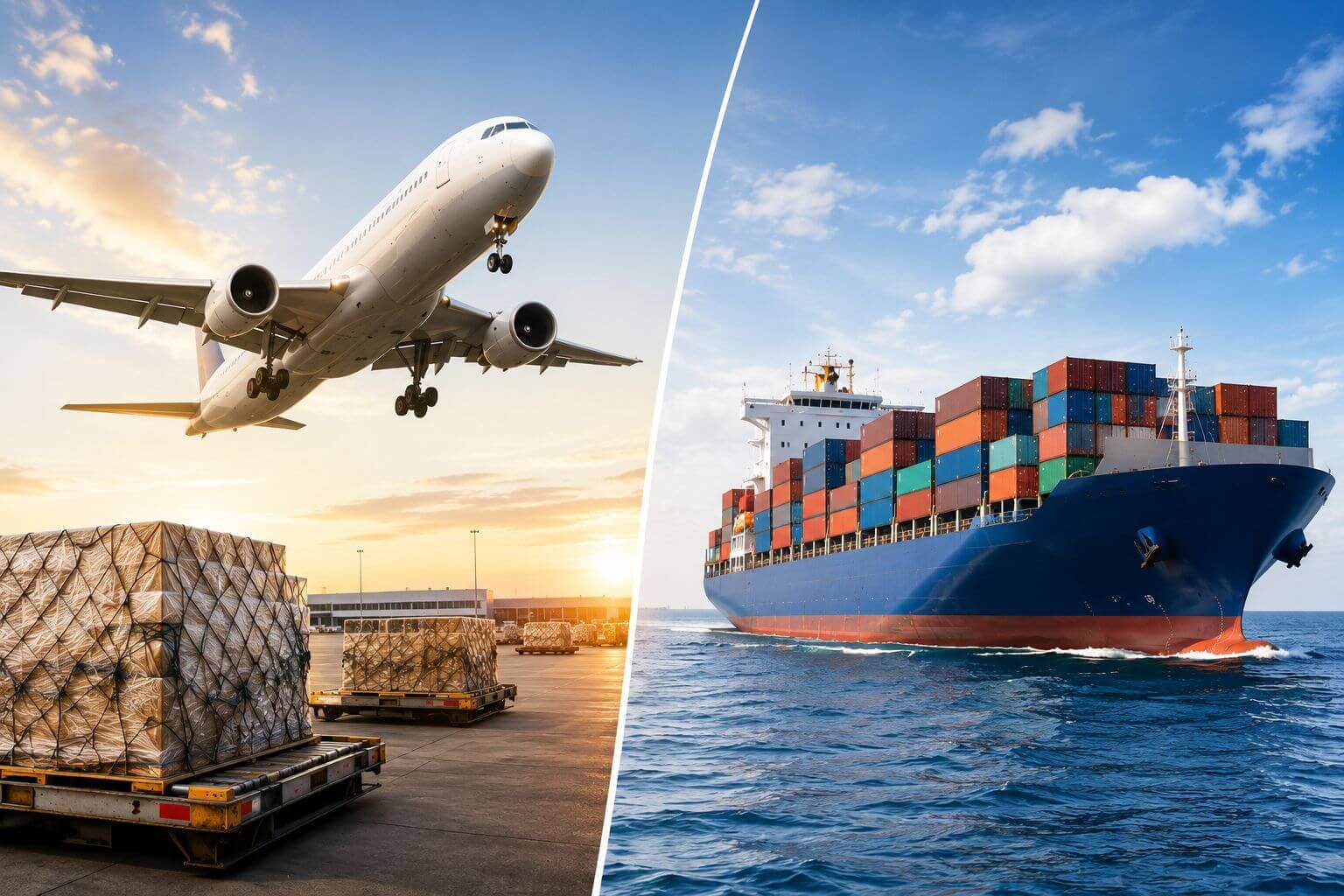
Air Freight vs Sea Freight: Which Shipping Method Is Right for Your Business?
Every business shipping goods internationally eventually asks the same question: air or sea? The answer isn’t the same for every shipment. Air freight and sea freight solve different problems, and choosing the wrong one can quietly eat into your margins or delay a launch you can’t afford to delay. Here’s how the two compare, when each makes sense, and how to decide with confidence for your next shipment out of India.
What Are the Main Differences Between Air Freight and Sea Freight?
Air freight and sea freight differ mainly in speed, cost, capacity, and the type of cargo each is built for. Air freight moves goods on cargo or passenger aircraft, making it the fastest way to cross borders. Sea freight moves goods in containers on cargo vessels, making it the most economical way to move large volumes over long distances. Businesses exporting from hubs like Mumbai, Delhi, and Chennai typically weigh these differences against urgency, product value, and budget before deciding.
Speed
Air freight typically takes one to five days for most international routes; sea freight can take two to six weeks depending on destination and port congestion.
Cost
Air freight is priced by chargeable weight, which makes it costlier per kilogram. Sea freight is priced by container or cubic volume, bringing the per-unit cost down significantly for bulk cargo.
Cargo Capacity and Type
Aircraft have space and weight restrictions, so air freight suits lightweight, high-value, or time-sensitive goods. Ships carry far larger volumes, making sea freight the natural choice for bulk raw materials, machinery, and non-urgent inventory.
| Factor | Air Freight | Sea Freight |
|---|---|---|
| Transit Time | 1 to 5 days for most international lanes | 2 to 6 weeks, depending on the route |
| Cost | Higher per kg, priced on weight/volume | Lower per unit, priced on container/volume |
| Best For | Urgent, high-value, perishable or lightweight cargo | Bulk, heavy, non-urgent shipments |
| Documentation | Air Waybill (AWB), commercial invoice, packing list | Bill of Lading (BOL), commercial invoice, packing list |
| Reliability | High schedule consistency, fewer weather disruptions | Subject to port congestion and longer transit variability |
Is It Cheaper to Ship by Air or Sea?
Sea freight is almost always cheaper per kilogram, especially for heavy or bulky shipments. Air freight costs more because it’s priced on chargeable weight (whichever is higher between actual and volumetric weight) and reflects the premium of faster transit. But cost isn’t only about the freight rate; air freight often reduces warehousing and inventory holding costs because goods reach the buyer faster, which can offset the higher shipping charge for time-sensitive or high-value products.
Which Is Faster, Air Freight or Sea Freight? How Long Does Each Take?
Air freight is significantly faster. A shipment from India to Europe by air typically arrives within two to four days, versus three to five weeks by sea. For India to the US, air freight generally takes three to six days against four to six weeks by sea. Route, customs clearance, and carrier schedules affect the exact timeline, but the gap between the two modes stays substantial across every major trade lane.
How to Choose Between Air Cargo and Ocean Cargo for International Shipments from India?
Choosing between air freight and sea freight from India comes down to four practical factors:
- Urgency: If your buyer needs stock within days, air freight is the only realistic option.
- Product value: High-value goods like electronics or pharmaceuticals often justify air freight, since faster transit lowers risk.
- Shipment size and weight: Bulk or heavy cargo is almost always more economical by sea.
- Budget flexibility: If margins can absorb a higher cost for speed, air freight is worth it; otherwise, sea freight wins.
Many Indian exporters use a mixed approach too, moving urgent or high-value portions of an order by air while shipping the bulk by sea. This is where multimodal air-sea and sea-air solutions come in handy, letting businesses balance cost and speed on a single order instead of committing entirely to one mode.
Which Is Better, Air Freight or Sea Freight? The Honest Answer
Neither mode is universally better; each is built for a different job. Air freight wins on speed, reliability, and predictability, which matters for perishables, pharmaceuticals, e-commerce, and anything with a tight deadline. Sea freight wins on cost efficiency for bulk, heavy, or non-urgent cargo. The right freight forwarding partner should advise on both, not push you toward one mode by default.
When Should You Use Air Freight Instead of Sea Freight?
Air freight is the right call when:
- Your shipment is time-critical, such as pharmaceuticals, vaccines, or perishables with a limited shelf life.
- You’re shipping high-value or fragile items like precision electronics, where less handling lowers risk.
- You need to prevent downtime, such as urgent aircraft parts or industrial spares.
- A sudden demand spike or stockout requires fast replenishment to avoid losing sales.
- Your cargo is lightweight or low-volume, where air freight’s cost premium is smaller in absolute terms.
Small Business Shipping: Air Freight or Sea Freight?
For small and medium businesses, the decision usually comes down to volume and cash flow rather than a strict speed-versus-cost trade-off. Full container sea freight can be out of reach for smaller shipment sizes, which is where consolidation helps. By combining shipments from multiple SMEs heading to similar destinations, freight forwarders can offer competitive air freight rates without the cost burden of booking full capacity alone, letting smaller exporters compete globally and scale into new markets without overcommitting cash to logistics.
What Documentation Is Required for Air Freight Exports from Mumbai?
Air freight exports from Mumbai, like most Indian gateways, require a standard documentation set to clear customs and move smoothly through the airline network:
- Air Waybill (AWB), issued by the airline or freight forwarder
- Commercial Invoice and Packing List
- Shipping Bill, filed electronically via ICEGATE
- Certificate of Origin, where required by the destination country
- Import Export Code (IEC) registration for the exporter
- Product-specific certificates for regulated goods (pharma, dangerous goods, perishables)
An experienced freight forwarder typically manages this documentation end-to-end, reducing the risk of customs delays and keeping time-sensitive shipments on schedule.
Which Companies Offer the Fastest Air Freight Solutions from India to the World?
The fastest air freight providers from India to World are usually forwarders with direct airline partnerships, strong gateway presence, and priority capacity access, since these factors decide how quickly cargo gets uplifted rather than waiting for the next available flight.
Skyways Group is one such provider. With over four decades in global logistics and operations across 31 locations in India and 11 countries, Skyways has been ranked India’s Number 1 Air Freight Forwarder by AWB generation for three consecutive years (2022, 2023, 2024), per the World ACD Report. Performance-based agreements with leading international airlines give Skyways priority capacity access on key India-Europe lanes, supporting consistent transit times even during market volatility. Explore Skyways’ air freight services for time-critical and specialised cargo moving from India to Europe and beyond.
Where Can I Book International Sea Freight Shipping from India Online?
Sea freight bookings from India are typically arranged through freight forwarders or shipping lines rather than fully self-service online portals, since ocean shipments involve container allocation, port scheduling, and customs documentation that benefit from expert coordination. If your business ships a mix of air and ocean cargo, working with one freight forwarder that offers air-sea and sea-air multimodal solutions simplifies things considerably. Skyways Group integrates air, sea, road, and warehousing services on one operational platform with real-time tracking, so you can coordinate sea freight alongside your air cargo without managing multiple vendors. Reach out to the Skyways team for a sea freight quote and booking support on your route.
Frequently Asked Questions
What are the main differences between air freight and sea freight services in India?
Air freight is faster, more expensive per kilogram, and suited to lightweight, high-value, or time-sensitive cargo. Sea freight is slower, more economical for bulk or heavy shipments, and priced by container or cubic volume rather than weight. Most Indian exporters choose based on urgency, product value, and shipment size.
Which companies offer the fastest air freight solutions from India to Europe?
Forwarders with direct airline partnerships and strong gateway presence typically offer the fastest transit. Skyways Group, ranked India’s Number 1 Air Freight Forwarder by AWB generation for three consecutive years (2022-2024) per the World ACD Report, is one such provider, with priority capacity access across major India-Europe lanes through its air freight services.
How do I choose between air cargo and ocean cargo for international shipments from India?
Base the decision on four factors: how urgently the shipment is needed, the value of the goods, the weight or volume involved, and how much budget flexibility you have. Time-critical or high-value cargo generally favours air; bulk or non-urgent cargo generally favours sea. Many businesses split a single order across both modes.
Where can I book international sea freight shipping from India online?
Sea freight is usually booked through a freight forwarder or shipping line rather than a fully self-service portal, since container allocation and customs documentation benefit from expert coordination. Freight forwarders offering integrated air-sea solutions, such as Skyways Group, let you arrange sea freight bookings alongside air cargo through one point of contact.
What documentation is required for air freight exports from Mumbai?
Standard requirements include an Air Waybill (AWB), commercial invoice and packing list, a Shipping Bill filed via ICEGATE, IEC registration for the exporter, a Certificate of Origin where applicable, and any product-specific certificates for regulated goods such as pharmaceuticals or dangerous goods.
Air and Sea Freight Services: Choosing the Right Freight Forwarding Partner
Air freight and sea freight aren’t competing options as much as complementary tools. The right choice depends on how urgently your goods need to arrive, what they’re worth, how much they weigh, and how much budget flexibility you have. For time-critical, high-value, or perishable cargo, air freight earns its premium. For bulk, heavy, or planned inventory, sea freight remains the more economical path. Many businesses end up using both, shifting between modes as order size and urgency change.
Working with an experienced air and sea freight forwarder takes the guesswork out of this decision. Skyways Group brings four decades of logistics expertise, strong airline partnerships, and integrated air-sea freight solutions to help Indian businesses move cargo reliably, whichever mode fits the shipment. Get in touch with Skyways Group to discuss the right air freight or sea freight solution for your next shipment.